Babbitt bearing repair vs. buying new
A worn or wiped babbitt layer almost never means you need a new bearing. In most cases the bearing shell is still sound and only the babbitt is replaced. Such a repair typically costs 20–30% of a new part and takes 10–15 working days.
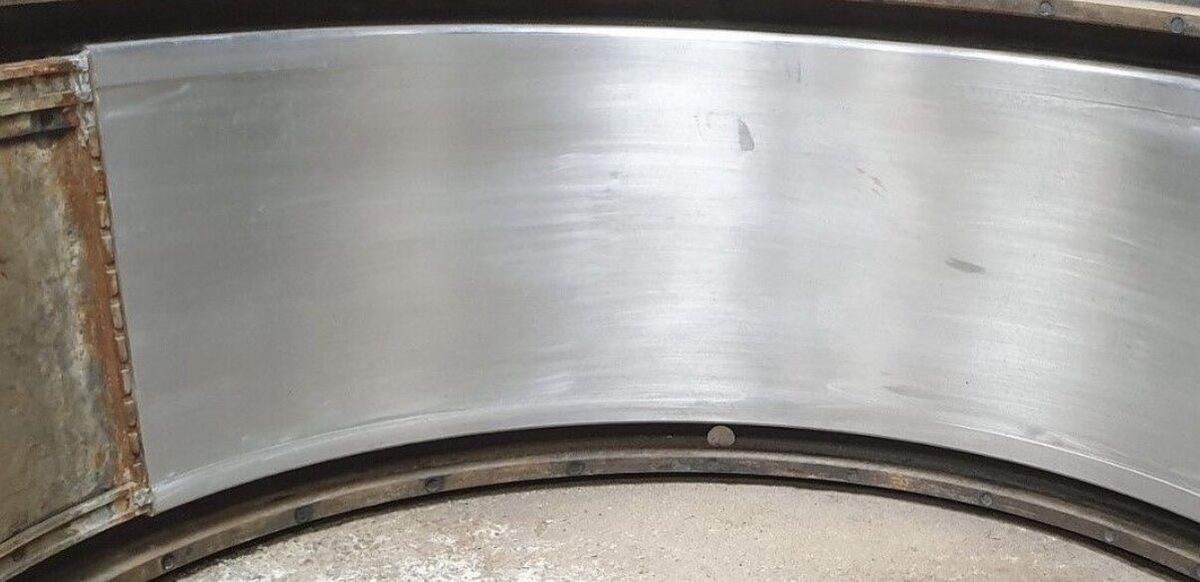
When a bearing can be repaired
What decides is the condition of the steel or cast-iron shell, not the babbitt — the babbitt is fully removed and re-poured anyway.
Repair is possible if
- the babbitt is worn, wiped, scored or has come away from the shell;
- the shell has cracks that can be repaired before re-pouring — as in the example below;
- the shell geometry and fit surfaces are within the drawing.
A new bearing is needed if
- the shell is deformed or the cracks cannot be repaired;
- there is no old bearing and the equipment is no longer made.
In the second case we manufacture a new bearing to drawing or by measuring a worn sample. The incoming inspection gives the final answer, but photos are often enough for a first assessment.
How the repair works
The repair runs in five steps, and every bearing ships with an inspection report.
- 01Incoming inspection. We measure the shell, map defects and check the backing before any work starts.
- 02Removal and tinning. The old layer is melted out, the base is cleaned and tinned. The bond between babbitt and steel depends on this step.
- 03Casting. The new layer is cast from our own alloy — static or centrifugal, depending on size and geometry.
- 04Machining. The bearing surface is bored, and oil grooves and joint faces are machined to your drawing or to the original dimensions.
- 05Final inspection. Ultrasonic bond test, dye penetrant inspection, alloy analysis and a dimensional report. The report ships with the bearing.
Cost and lead time
A repair typically costs 20–30% of a new bearing: you do not pay for the shell or for making it.
| Re-babbitting | New bearing | |
|---|---|---|
| Cost | 20–30% of the new price | 100% |
| Lead time | 10–15 working days from receipt | depends on the manufacturer |
| Shell (steel or cast iron) | your own, inspected | new |
| Quality control | UT, dye penetrant, alloy analysis, report | to the manufacturer's standard |
Lead time depends on size and quantity. We handle bearings with bores from 100 to 3,000 mm and weights up to 5 t.
Babbitt alloys
We pour the grade your equipment manufacturer specifies. We produce the babbitt ourselves.
| Standard | Grades |
|---|---|
| GOST | B83, B16 |
| ASTM B23 | Grade 1, 2, 3, 7, 8 |
| ISO 4381 | SnSb12Cu6Pb, SnSb8Cu4, PbSb15Sn10 |
Tin-based alloys (B83, SnSb12Cu6Pb, SnSb8Cu4) are used for the most heavily loaded and high-speed bearings, including turbines. Lead-based alloys (B16, PbSb15Sn10) for less critical positions.
Example: a 2,000 mm, 4.5 t bearing
In 2021 we received a bearing with a 2,000 mm bore and a weight of 4.5 t that was due to be scrapped. The babbitt was worn and damaged, and the shell had cracks.
We removed the old babbitt, repaired the cracks, poured a new layer and machined it on a vertical lathe. The bearing is back in service, and the customer avoided buying a new one.
What to send for a quote
You receive a quote within 48 hours. We need:
- a drawing (PDF or DWG) or clear photos of the bearing
- main dimensions: bore, length, outside diameter
- the babbitt grade, if known
- quantity and required delivery date
Frequently asked questions
How many times can a bearing be re-babbitted?
As long as the shell passes the incoming inspection, it can be re-babbitted again.
Can you repair a bearing without a drawing?
Yes. We machine it to the original dimensions taken during the incoming inspection.
How do you check the bond quality?
Every bearing is checked by ultrasonic bond testing and dye penetrant inspection, and the alloy is analysed. The report ships with the part.
Do you make single pieces?
Yes — single pieces as well as small series.
Which bearings do you repair?
Journal and thrust bearings of turbines, generators, electric motors, pumps, fans and compressors, plus bushings for crushers, mills and presses — split and solid.